
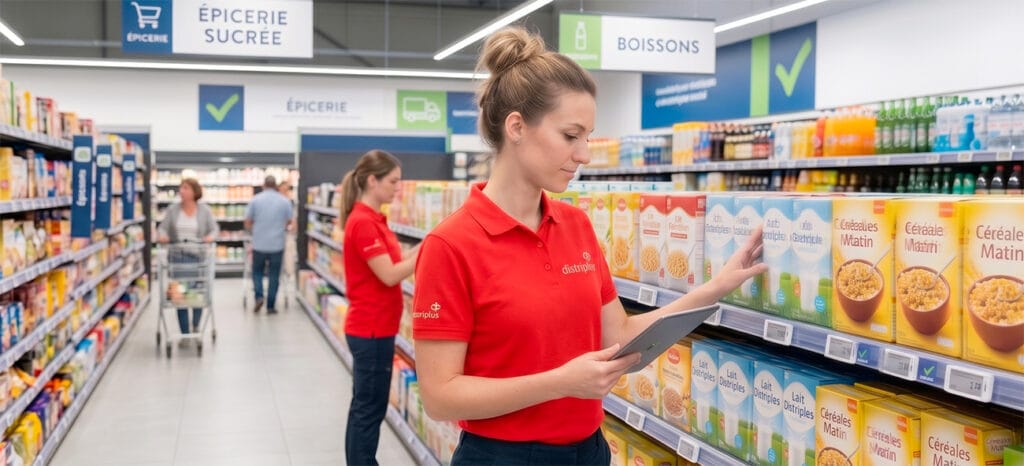
Product Listing in Mass Retail: Successfully Launching in Supermarkets and Supermarket Chains
Product placement in mass-market retail is a critical step in a brand’s commercial development. Simply being stocked in a store does not guarantee success; it is also essential to secure favorable conditions regarding placement, visibility, and turnover.
In an environment dominated by purchasing groups and the consolidation of retail chains, product placement has become a strategic process requiring a structured approach that combines negotiation, on-the-ground execution, and sell-out management.
At Distriplus, we support brands throughout the entire process of getting their products listed in mass retail, from market entry strategy to point-of-sale optimization.
Understanding Product Listing in Retail
Product listing refers to the process of adding a product to the catalog of a large retail chain (supermarket or hypermarket), along with the assignment of a product code and a location in the store or warehouse.
It involves several aspects:
- National or regional search engine optimization
- Agreement through a purchasing cooperative or directly with the store
- Related terms and conditions (pricing, discounts, RFA)
- Definition of the merchandising plan
- Establishment of logistical arrangements
Listing is therefore a key business strategy, but also an operational commitment between the brand and the retailer.
The Challenges of Listing in Supermarkets and Hypermarkets
1. Access strategic brands
Getting listed allows you to enter key distribution channels:
- Supermarket
- Specialty retail store
- Networks of independent professionals
2. Generate volume from the outset
Good SEO isn't enough: it must be accompanied by a launch strategy to ensure:
- Immediate visibility
- A quick rotation
- A product adoption on the shelf
3. Ensure profitability
Listing requirements have a direct impact on:
- Manufacturer's net margin
- Marketing costs (RFA, discounts, promotional budgets)
- The overall profitability of the circuit
The Key Steps to Successful Product Listing
1. Strategic planning in advance
- Category and Competitor Analysis
- Identification of target retailers
- Developing a clear value proposition
- Defining Target Commercial Terms
2. Approach of central purchasing agencies
Listing typically involves structured negotiations with the exchanges:
- Category Management Case Study
- Retail Business Plan
- Revenue Forecast
- Store Activation Plan
3. Negotiating listing terms
Key points include:
- Suggested retail price
- Terms and Conditions for Retailers
- Logistics Referencing
- Volume commitments
- Promotional Terms and Conditions
4. Point-of-sale deployment
Search engine optimization must be enabled:
- Shelf placement
- Promotional feature
- Adherence to the merchandising plan
- Tracking sell-out performance
Why Some Product Listings Fail in Supermarkets
A product can be listed without generating any actual sales. The main reasons are:
- Lack of visibility on the shelf
- Lack of on-the-ground support
- Poorly calibrated commercial terms
- Low product turnover
- Lack of follow-up after listing
SEO should therefore be viewed as an ongoing process, rather than simply a one-time validation of a brand’s online presence.
Distriplus’s Approach to Product Listing
At Distriplus, we provide services across the entire value chain of retail merchandising.
1. SEO Strategy
- Identification of priority retailers
- Potential Analysis by Category
- Pricing and Product Offering
2. Centralized negotiation
- Preparing for buyer meetings
- Developing sales pitches
- Defending Listing Criteria
3. Field Activation
- Point-of-sale deployment
- Coordination with store teams
- Merchandising Optimization
4. Performance Management
- DN/DV Monitoring
- Turnover Analysis
- Adjustments to sales action plans
Search Engine Optimization and Sales Performance: An Integrated Approach
Search engine optimization can no longer be viewed in isolation from the rest of the business strategy.
Successful brands now combine:
- Effective central bargaining
- Active field sales force
- Pooling of sales resources
- Continuous sell-out management
This integrated approach ensures that search engine traffic is converted into actual revenue.
Product Listing: GSA vs. GSS
Large-scale food retail
- High volumes
- Strong price pressure
- The Importance of Promotions
- Need for rapid turnover
Specialty Retail (GSS)
- Greater product expertise
- Quality Focus
- The Importance of Customer Service and Merchandising
- Higher average basket size
Why choose Distriplus?
- Extensive expertise in GSA and GSS purchasing groups
- Performance-driven sell-out approach
- Expertise in complex commercial negotiations
- National field deployment capability
- A model that combines strategy and execution
FAQ – Product Listing for Mass Retailers
How can I get my products listed in major retail chains?
We need to develop a clear value proposition, negotiate with purchasing groups, and demonstrate the potential for in-store performance.
What is the difference between listing and distribution?
Le référencement est l’accord commercial, la distribution est la présence réelle et active en point de vente.
Why isn't a listed product selling?
Often due to a lack of on-the-ground outreach, visibility, or poor pricing strategy.